Built from years on the ground, not a boardroom.
The Impact Conduit didn't start as a platform. It started in 2005, with a donation box on a university campus — and nearly two decades of learning what makes giving actually work.
Where this started
In October 2005, a devastating earthquake struck Pakistan. The founder of The Impact Conduit was a university student in Kuantan, Malaysia at the time — far from the disaster, but unwilling to treat distance as a reason to do nothing. Starting in November 2005 and carrying through into early 2006, the response was simple: donation boxes placed around campus, partner institutions recruited to do the same, and every ringgit collected channeled through the Malaysian Red Crescent Society.
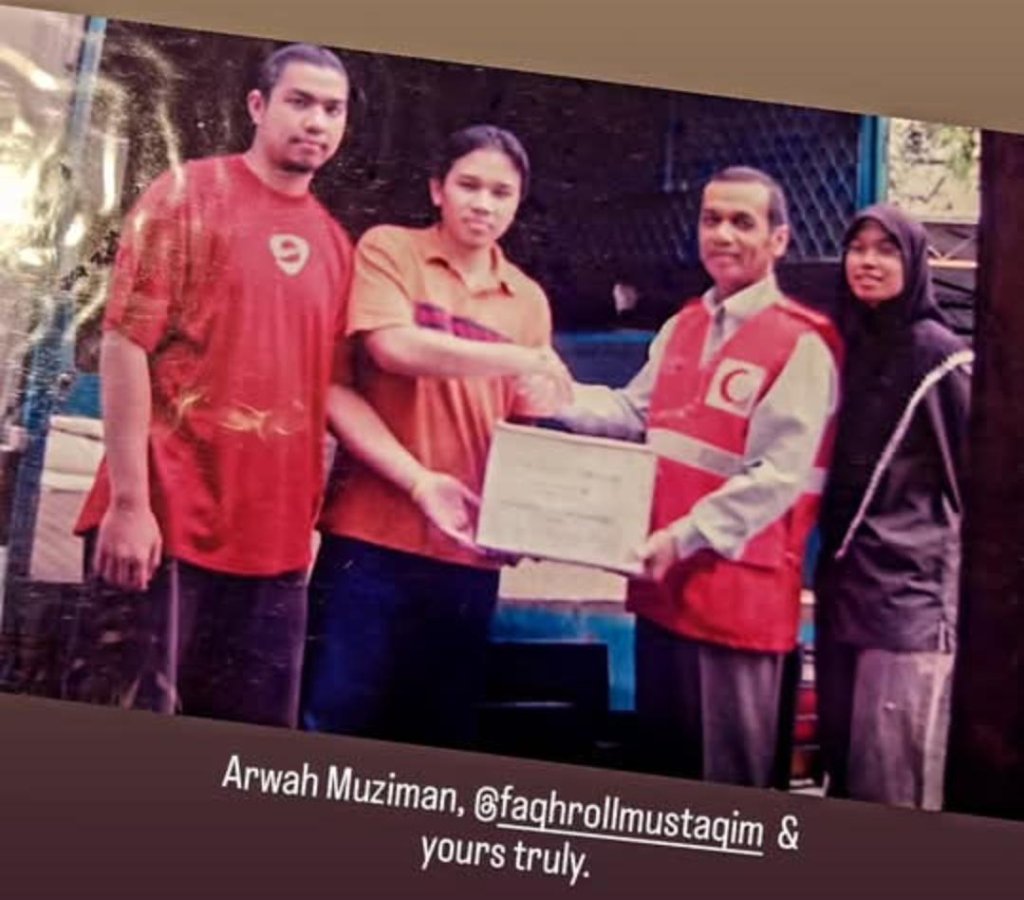
Handover of collected funds to the Malaysian Red Crescent Society, 2005–06 Pakistan earthquake relief effort.
That same instinct — see a need, find the fastest honest way to meet it — defined the next eighteen years. In 2011, a fundraiser for Japan tsunami and earthquake victims raised RM21,000 — well past its original RM10,000 target — backed by a 100km Sundown Ultramarathon in Singapore, completed in close to 18 hours and through an unexpected bout of hypothermia. The result was covered by the New Straits Times and Berita Harian, and the funds were formally presented to the Malaysian Red Crescent Society at a ceremony attended by Mr. Koichi Ito, Deputy Chief of Mission at the Embassy of Japan in Malaysia. Through the 2020s, the work shifted toward sustained, local action: street feeding in Kuala Lumpur, the Street Library movement for the urban poor, Ramadhan food baskets, and support for university students and mosque congregations.
When Pahang flooded in 2020 and 2021, the response went beyond raising money — it meant figuring out exactly what was needed and getting it there without waste. Item lists were carefully curated with village heads and local authorities first, so what arrived matched what was actually requested: mattresses, gas stoves, kain batik, and other essentials specific to each affected area. Working directly with local authorities and the police helped connect that effort to village heads and local officers on the ground, reaching people that slower official channels couldn't.
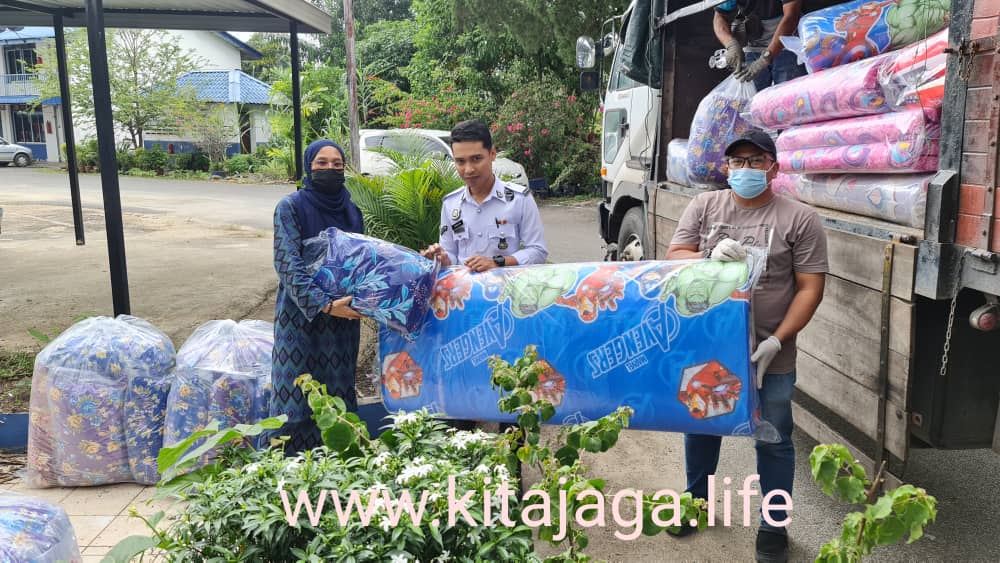
Mattress delivery handover during the 2020–21 Pahang floods.
When Pahang flooded again in 2022 and 2023, the same coordinated approach scaled up further: relief funds, equipment rentals to clear mud, and house-cleaning teams of university students working alongside local authorities. That access led to help that went beyond flood relief — preloved books for a damaged school, eye surgery for a man who needed it, home supplies for an elderly man living alone, a roof for someone who had none.
Along the way, this work ran under the name kitajagalife — a personal, fast-moving alternative to traditional NGO processes, reporting every contribution back to donors directly. The Impact Conduit is the next chapter of that same work — the same philosophy, now built into a platform that others can use too.
In October 2005, a devastating earthquake struck Pakistan. The founder of The Impact Conduit was a university student in Kuantan, Malaysia at the time — far from the disaster, but unwilling to treat distance as a reason to do nothing. Starting in November 2005 and carrying through into early 2006, the response was simple: donation boxes placed around campus, partner institutions recruited to do the same, and every ringgit collected channeled through the Malaysian Red Crescent Society.
That same instinct — see a need, find the fastest honest way to meet it — defined the next eighteen years. In 2011, a fundraiser for Japan tsunami and earthquake victims raised RM21,000 — well past its original RM10,000 target — backed by a 100km Sundown Ultramarathon in Singapore, completed in close to 18 hours and through an unexpected bout of hypothermia. The result was covered by the New Straits Times and Berita Harian, and the funds were formally presented to the Malaysian Red Crescent Society at a ceremony attended by Mr. Koichi Ito, Deputy Chief of Mission at the Embassy of Japan in Malaysia. Through the 2020s, the work shifted toward sustained, local action: street feeding in Kuala Lumpur, the Street Library movement for the urban poor, Ramadhan food baskets, and support for university students and mosque congregations.
When Pahang flooded in 2020 and 2021, the response went beyond raising money — it meant figuring out exactly what was needed and getting it there without waste. Item lists were carefully curated with village heads and local authorities first, so what arrived matched what was actually requested: mattresses, gas stoves, kain batik, and other essentials specific to each affected area. Working directly with local authorities and the police helped connect that effort to village heads and local officers on the ground, reaching people that slower official channels couldn't.
When Pahang flooded again in 2022 and 2023, the same coordinated approach scaled up further: relief funds, equipment rentals to clear mud, and house-cleaning teams of university students working alongside local authorities. That access led to help that went beyond flood relief — preloved books for a damaged school, eye surgery for a man who needed it, home supplies for an elderly man living alone, a roof for someone who had none.
Along the way, this work ran under the name kitajagalife — a personal, fast-moving alternative to traditional NGO processes, reporting every contribution back to donors directly. The Impact Conduit is the next chapter of that same work — the same philosophy, now built into a platform that others can use too.
Recognized along the way
New Straits Times & Cheque Presentation — Embassy of Japan
The New Straits Times (byline: Fariz Iswadi Ismail) covered the fundraiser, reporting that Nor Juliana Ali completed the 100km Sundown Ultramarathon in Singapore in close to 18 hours through an unexpected bout of hypothermia — raising RM21,000, well past her RM10,000 target. The funds were formally presented as a mock cheque to the Malaysian Red Crescent Society, received by Mr. Koichi Ito, Deputy Chief of Mission at the Embassy of Japan in Malaysia, at a ceremony held at Menara Multi-Purpose, Kuala Lumpur.
Berita Harian
The fundraiser was also covered in Bahasa Malaysia, under the headline "Juliana gigih bantu mangsa tsunami" ("Juliana works tirelessly to help tsunami victims").
IIUM Takrim Award — Nominee
Nominated for IIUM's 2026 Takrim Award, an annual recognition given by the university to alumni for outstanding effort and achievement.
"Help that isn't coordinated can be wasted."
Why Transparency Isn't Optional
An elderly man once received so many rice donations that what he couldn't eat rotted before it could be used by anyone else. Aid given without context doesn't just fail to help — it can quietly do harm, or teach the people receiving it to expect rather than to build.
The Pahang floods proved the opposite was possible too. By curating item lists directly with village heads and local authorities before sourcing anything, the right mattresses, gas stoves, and kain batik reached the right households — nothing duplicated, nothing wasted.
That's the problem The Impact Conduit exists to solve. Every project on the platform tracks what was given, what it was used for, and what it achieved — so support reaches people in a way that actually moves their lives forward, not just a way that feels good to give.
A Network Changes What's Possible
Raising help alone is hard. Most people who need it don't know where to start, and most people willing to give don't know where their help is needed. The gap between the two is where The Impact Conduit lives.
That gap is closeable. When two close friends were tested by tragedy — one by a serious accident, the other by cancer — a coordinated fundraising effort raised roughly RM13,000 between them, covering hospitalization, transport, and the rehabilitation costs that often get forgotten once the initial emergency has passed. None of it happened because one person had deep pockets. It happened because the right people were given the right space, time, and opportunity to help, together.
That's the thesis behind everything The Impact Conduit does: a caring society isn't short on willingness to help. It's short on connection. Build the connection, and the help follows.
Value Beyond Dollars and Cents
When the connection is real — a smile recognized across repeat visits, a family welcoming strangers into their home, time spent over a meal with someone you just met — something is exchanged that a budget line can't capture. These are qualities and values traded between two parties, not simply handed from one to the other.
That's what we believe makes this model worth being part of: not just moving money efficiently, but building something that holds real, human value on both sides.
That said, none of this runs on goodwill alone. Coordinating it — the visits, the verification, the follow-through — takes real time, manpower, and cost. Funders and supporters who can help with any of these are welcome in this community.
Where we put our energy
The Impact Conduit concentrates on five pillars where sustained, well-coordinated effort makes the biggest difference. Two of these show up directly in the work described above — our Resource Hub lives under Sustainable Resource Management, and SEA Heroes, our ongoing project documenting the forgotten figures of Southeast Asian history, lives under Holistic Heritage Preservation.
Education Waqf
Channelling endowment-style giving into sustained educational access for those who need it most.
Social Development
From street feeding to community programmes — supporting people where they are, with what they actually need.
Training
Equipping individuals and communities with skills that build long-term self-sufficiency and capability.
Sustainable Resource Management
Our Resource Hub lives here — matching preloved goods to people who can use them, reducing waste while meeting real needs.
Holistic Heritage Preservation
SEA Heroes lives here — documenting the forgotten figures of Southeast Asian history before their stories are lost.
Our mission: To be the conduit that connects funders and volunteers directly to the causes that need them most — and to make every contribution visible, trackable, and accountable, from the first dollar to the final result.
Why it matters to us: We've seen what happens when help is given without coordination or follow-through. The Impact Conduit exists to make sure that doesn't happen — to the people who give, and to the people receiving.
The Impact Conduit is a social enterprise registered as Saluran Impak (MA0346037-X).